

Natural Oak vs. Weathered Oak — Which Finish Is Right for Your Interior?
When choosing a solid oak table or chair, one of the first decisions you’ll make is the finish. It’s not just an aesthetic choice—the finish determines the piece’s character, how it fits into your interior, and how it will age over time. And the difference between natural oak and weathered oak is more profound than it seems at first glance.
What Both Finishes Have in Common—and Why It Matters
Before looking at the differences, it’s important to understand what they have in common. Both the natural and weathered finishes are oil-based. There is no varnish, no synthetic coating that covers the surface and artificially “seals” it. The oil penetrates the wood’s grain, protecting it from the inside and leaving its texture vibrant, breathable, and tactile.
This choice has a very important practical consequence that few people mention: Any part that has been treated with oil can be repaired locally.
If you stain or scratch the surface—which is inevitable on a table used every day—you don’t have to refinish the entire piece. Simply sand the affected area and reapply the treatment. The table will return to its original condition without any marks or visual compromises. For weathered pieces, we also offer a dedicated repair kit, so you can fix it yourself whenever you need to.
That’s the fundamental difference from a lacquered finish, where a deep scratch or stain means you either have to live with it or refinish the entire surface. With oil-treated wood, there’s no such dilemma.
Natural Finish — Wood That Remains Wood
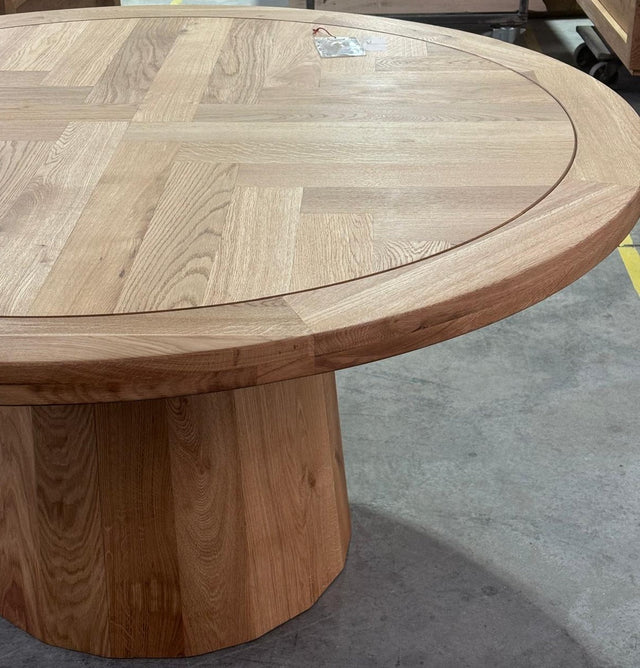
The natural finish is the most straightforward: solid oak treated exclusively with oil. The process brings out the warm, natural color of the oak—shades of beige, honey, and hazelnut—without altering the wood’s color palette or changing its texture.
The result is a piece that looks and feels exactly as it is. No two tables are alike, because no two trees are alike—variations in grain, natural knots, and subtle differences in color are part of its character, not flaws.
Over time, when exposed to natural light, a piece of furniture with a natural finish will gradually lighten in color—a gradual, natural process that adds depth to the piece without altering its character. Maintenance is simple: just apply a new coat of oil once every few years, or whenever you feel the wood “needs” some moisture.
The weathered finish — a deliberately created effect
"Weathered" literally means "exposed to the elements." The weathered finish shifts the oak’s color palette toward cooler tones—gray-beige, gray-brown, smoky gray—and visibly accentuates the grain’s texture. The process involves applying a specialized stain, followed by an oil treatment. It follows the same basic principle as the natural finish, with an additional step that fundamentally transforms the wood’s appearance.
The result is a piece that seems to already have a story behind it—a table that doesn’t look new, but rather like one that has been through a lot. This gives it a unique character that’s impossible to achieve with a fresh, bright finish.
The advantage of repairability is fully preserved here as well. The repair kit for weathered surfaces exactly matches the color and texture of the original finish, so that any local repairs remain invisible.
What the inside of each one looks like
- Warm tones — beige, honey, hazelnut
- Matte finish, feels natural to the touch
- Bright, open, fresh
- Subtle, visible wood grain
- It lightens slightly in color over time
- Oil Maintenance, Made Simple
- Cool tones — gray-beige, gray-brown, smoky gray
- A more pronounced texture to the touch
- Character, depth, the feel of a story-driven play
- The wood grain is clearly visible
- Chromatically stable over time
- Repair kit available
Which interior styles does each one work with?
Natural Oak — Modern, Scandinavian, and Minimalist Styles
If your interior features a light color palette, plenty of natural light, and a clean visual aesthetic, a natural finish is the obvious choice. It blends perfectly with Scandinavian style, contemporary minimalism, and designs that emphasize honest materials and airy spaces.
It pairs exceptionally well with upholstery in natural tones—wool, bouclé, linen—and with metallic accents in brass or brushed steel.
Weathered oak — rustic, industrial, Japandi, and wabi-sabi styles
The weathered finish has a bolder character and calls for an interior that can complement it. It pairs perfectly with industrial style—combined with matte black metal, exposed concrete, or brick. It works just as well in Japandi interiors, where the contrast between the wood’s pronounced texture and the simplicity of the forms creates a very well-controlled visual tension.
Paired with upholstery in earthy tones—terracotta, mustard, dark green, and anthracite—a weathered table becomes the focal point that anchors the entire composition of the room.
How do you choose between them?
The most useful question isn't "Which one is prettier?"—it's "Which room does this piece belong in, and what does it go with?"
- If your living room is bright, with warm tones and a clean style—natural oil-finished oak
- If your interior has character, bold textures, and a cooler or more earthy color palette—weathered oak
- If you're not sure, the safest combinations are: a weathered table with chairs upholstered in neutral tones, or a natural-finish table with cognac-colored leather chairs
- In both cases, you can request finish samples before placing your order—it's the easiest way to see how the color looks in the light of your room
All Verva tables and chairs are available in both finishes. If you’d like to see how a specific finish looks paired with a particular upholstery option, feel free to contact us at 0730 579 578 or contact@verva.ro —we’ll give you a clear answer, with no sales pressure.
Conclusion
Natural or weathered—there’s no wrong choice, just a choice that doesn’t fit the context. Both are beautiful finishes, applied to real solid wood with oil, without varnishes or artificial coatings. Both can be easily repaired in specific areas without having to redo the entire piece. The difference lies in character and color palette, not in quality or durability. Once you know what style you want to create in your room, the decision comes naturally.